Description
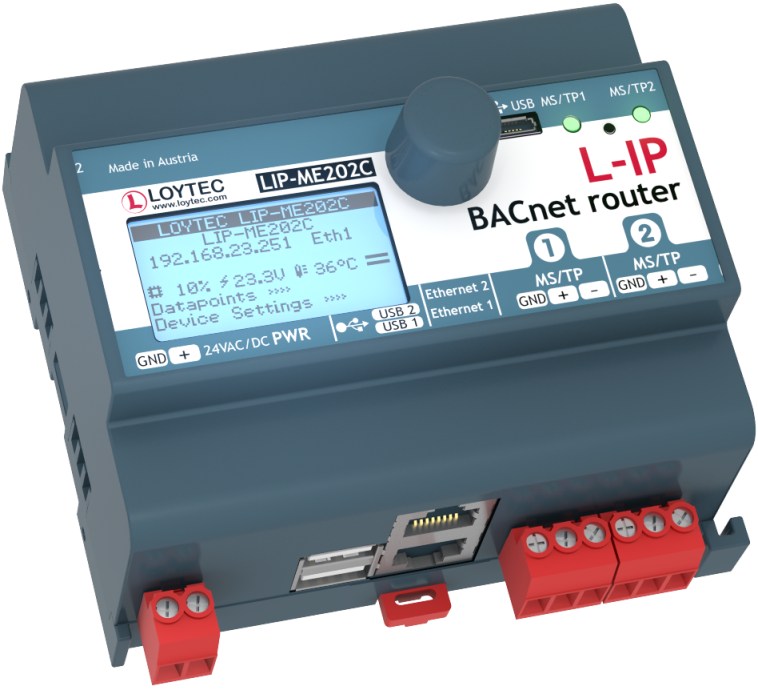
The LIP-ME202C BACnet/IP Routers connect BACnet MS/TP channels to a BACnet/IP network. The BACnet routers are compliant with the standards ASHRAE 135‑2012 and ISO 16484‑5:2012. The routers can be configured to act as a BACnet Broadcast Management Device (BBMD). The L-IP BACnet/IP Routers also provide Foreign Device support and BACnet/SC.
The LIP-ME202C BACnet router can act as a BACnet Time Master and as a BACnet MS/TP Slave Proxy. Extended features like the optional write protection of the BDT, a BACnet/IP Access Control List (ACL), and a simple communications test for BBMD help to locate issues on the network. The BACnet router also features remote MS/TP data packet capturing. BACnet MS/TP data packets are captured by the device and can be analyzed using Wireshark (free Protocol Analyzer, www.wireshark.org). Wireshark can either connect to the L-IP online or the capture file is loaded from the L-IPs web server and analyzed offline in Wireshark.
The entire device configuration of the BACnet router is done via the built-in web server, optionally also secured via HTTPS protocol. The BACnet router is BTL tested and WSPcert certified as BACnet Application Specific Controller (B-ASC).
Each LIP-ME202C BACnet/IP Router is equipped with two Ethernet ports. It can either be configured to use the internal switch to interconnect the two ports or every port is configured to work in a separate IP network.
When the Ethernet ports are configured for two separate IP networks, one port can be connected for instance to a WAN (Wide Area Network) with enabled network security (HTTPS) and BACnet/SC while the second port can be configured to be connected to an insecure network (LAN) where the standard building automation protocols like BACnet/IP are present. These devices also feature firewall functionality of course to isolate particular protocols or services between the ports. The built-in VPN function provides for simple VPN setup and secure access to remote sites. The LTE-800 interface enables wireless access to remote sites through a mobile carrier.
Using the internal switch, a daisy chained line topology of up to 20 devices can be built, which reduces costs for network installation. The IP switch also allows the setup of a redundant Ethernet installation (ring topology), which increases reliability. The redundant Ethernet topology is enabled by the Rapid Spanning Tree Protocol (RSTP), which is supported by most managed switches.